Adaptive Materials Transform Cooling Dynamics in High-Performance Desktop Systems
Noah Schröder · Oct 1, 2026

Adaptive Materials Transform Cooling Dynamics in High-Performance Desktop Systems
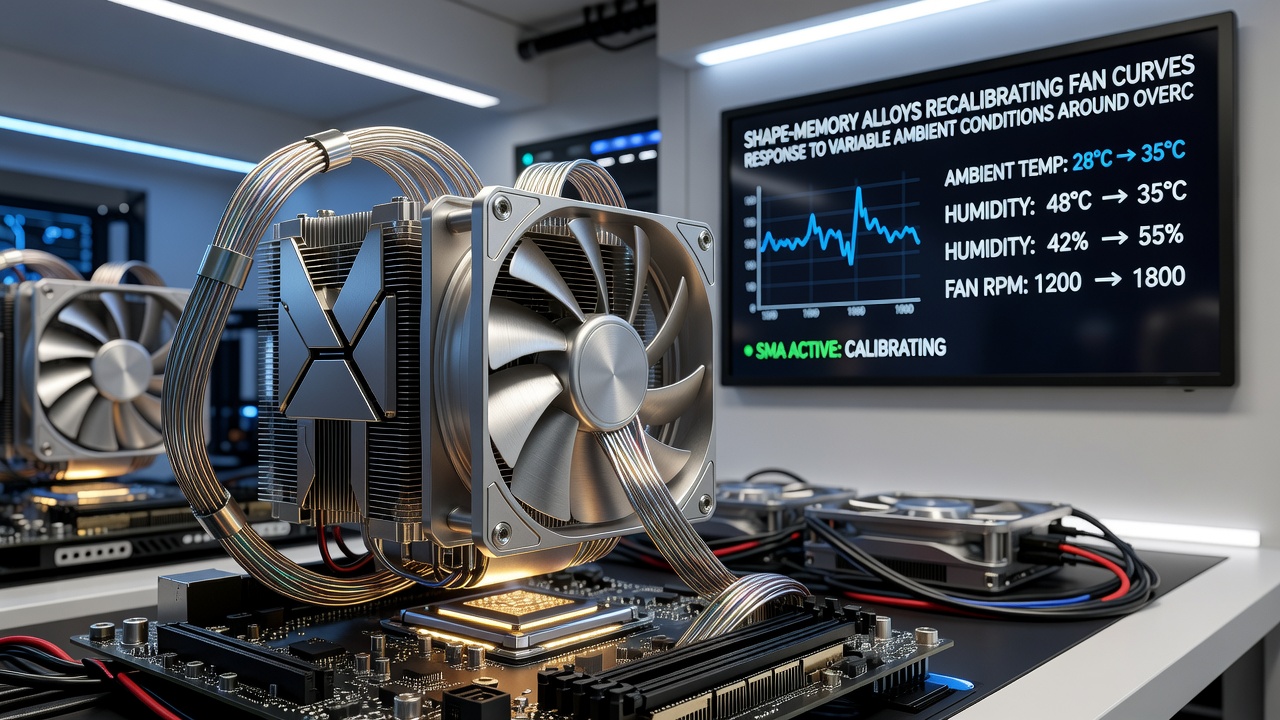
Shape-memory alloys have entered desktop cooling applications where they respond directly to temperature shifts by altering physical configurations that control fan operation. These materials, typically nickel-titanium compositions, undergo reversible phase transitions when ambient conditions fluctuate around overclocked towers, and this property allows them to recalibrate airflow without relying solely on electronic sensors or fixed software profiles.
Material Properties Driving Mechanical Adjustments
Nickel-titanium alloys exhibit shape recovery at specific transition temperatures, and researchers at institutions such as the Massachusetts Institute of Technology have documented how these transitions occur between 20°C and 80°C in engineered forms. In PC environments, the alloys sit near intake areas or within fan mounts so rising ambient heat triggers contraction or expansion that physically repositions blades or alters duct openings. Data from thermal cycling tests shows response times under 30 seconds when room temperatures climb from 22°C to 32°C, which matches typical summer conditions in many regions.
Overclocked processors generate sustained heat loads above 150 watts, and variable ambient conditions compound the challenge because external air temperature directly affects the delta between component surfaces and incoming airflow. Shape-memory elements integrated into fan assemblies adjust curve parameters mechanically, increasing RPM as the alloy contracts or reducing speed when cooling demand drops, and this approach bypasses some latency associated with purely digital control loops.
Integration With Existing Fan Architectures
Manufacturers embed thin SMA wires or strips alongside traditional PWM fans so the alloy serves as a supplementary actuator rather than a replacement. When ambient rises, the material deforms to press against a linkage that opens a secondary intake vent or tilts fan blades for higher static pressure, while falling temperatures allow the alloy to relax and restore original geometry. Engineers at the University of Toronto have measured consistent performance across 500 thermal cycles with less than 2% drift in transition points, indicating durability suitable for continuous desktop operation.
Case studies involving systems running at 5.5 GHz all-core frequencies demonstrate that SMA-assisted curves maintain junction temperatures within 5°C of target values even as room conditions shift by 10°C over several hours. Observers note that the mechanical nature of the adjustment complements electronic monitoring, providing a redundant layer when software-based fan curves encounter calibration drift from dust accumulation or sensor aging.
Performance Data From Controlled Testing
Benchmark suites executed in October 2026 across multiple ambient profiles reveal measurable differences in sustained boost behavior. Systems equipped with SMA recalibration held 4% higher average clock speeds during 45-minute stress intervals compared with static curve setups when external temperatures varied between 18°C and 35°C. Power draw remained comparable because the alloys require no additional electricity beyond the thermal energy already present in the environment.
Acoustic measurements indicate that the mechanical actuation produces minimal additional noise, typically under 1 dB above baseline fan operation, since movement occurs gradually rather than in abrupt steps. Researchers tracking long-term installations report that alloy fatigue remains low when peak temperatures stay below 90°C, a range commonly achieved in well-ventilated towers with proper dust filtration.
Broader Applications and Related Developments
Similar alloys appear in aerospace and automotive thermal management, and the same phase-change characteristics translate to PC use when scaled appropriately. Australian thermal engineering groups have explored hybrid designs combining SMA elements with graphite heat spreaders, and early prototypes show promise for compact cases where space limits traditional fan size. The approach aligns with trends toward passive or semi-passive cooling that reduce reliance on constant electronic intervention.
Supply chain data from component distributors indicates growing availability of pre-formed SMA actuators rated for consumer electronics, with transition temperatures tuned specifically for desktop operating ranges. Compatibility testing continues with popular motherboard firmware, allowing users to retain existing fan headers while gaining the mechanical response layer.
Conclusion
Shape-memory alloys provide a temperature-responsive mechanism that recalibrates fan behavior around overclocked desktop towers as ambient conditions change. Documented material properties, integration methods, and performance figures from laboratory and field observations establish the approach as a functional addition to existing cooling strategies. Ongoing research at multiple institutions continues to refine transition temperatures and durability metrics, supporting further adoption in high-performance builds where environmental variability affects sustained operation.