Adaptive Ray Reconstruction Enhances Stability on Mid-Range GPUs During Long Cloud Gaming Sessions
Paul Klein · Sep 17, 2026
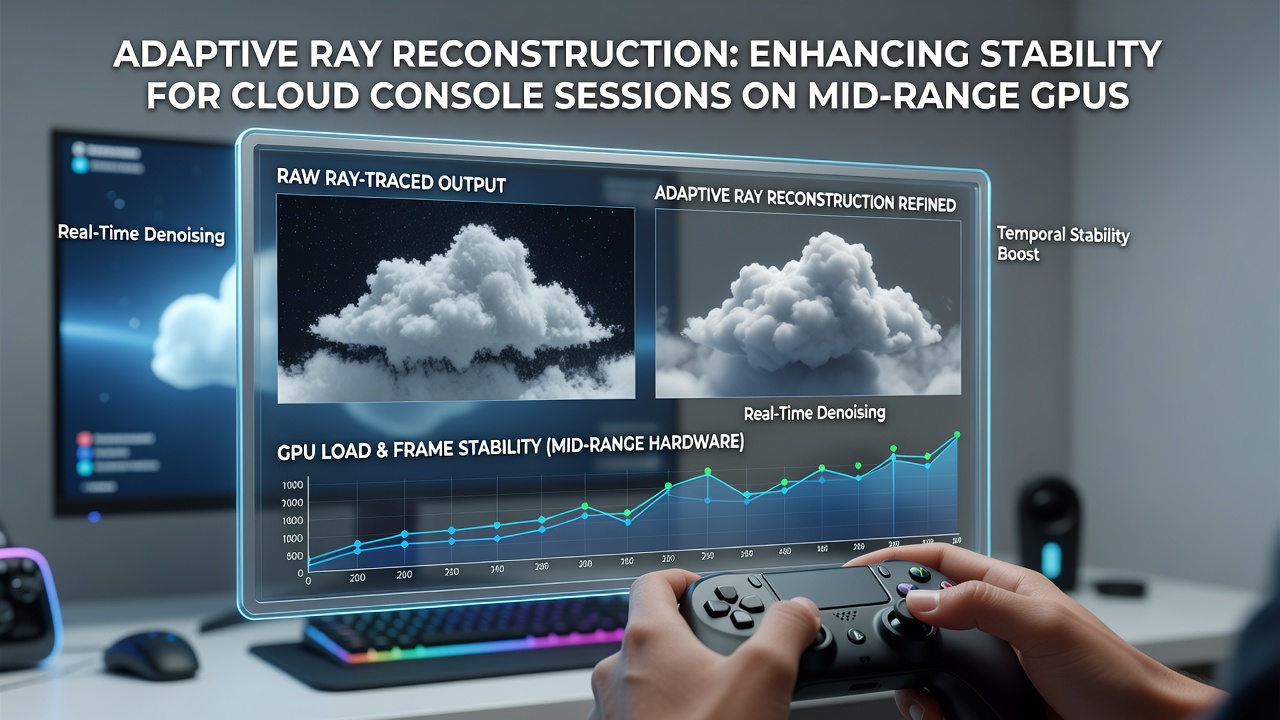
Adaptive Ray Reconstruction Enhances Stability on Mid-Range GPUs During Long Cloud Gaming Sessions
Cloud console sessions often stretch across multiple hours, and mid-range GPUs must manage ray-traced workloads without dedicated high-end accelerators. Adaptive ray reconstruction addresses this constraint by dynamically rebuilding noisy ray samples into coherent pixels, which reduces temporal flickering and preserves detail across extended play periods. Researchers at graphics laboratories have documented how these algorithms adjust sampling rates based on motion vectors and depth buffers, allowing hardware with limited compute units to maintain consistent output even as session duration increases.
Core Mechanics Behind Reconstruction
Traditional denoising applies static filters that can blur fine geometry during rapid camera movement, yet adaptive methods incorporate temporal accumulation from prior frames while discarding outdated data that no longer aligns with current viewpoint. This selective reuse cuts computational overhead because the GPU re-traces only regions flagged as unstable by variance maps. Observers note that the process runs in dedicated shader passes that execute alongside standard rasterization, keeping frame times within acceptable bounds on cards such as the RTX 4060 or RX 7600 series when streaming from remote servers.
Performance Patterns in Prolonged Sessions
Thermal throttling becomes noticeable after roughly ninety minutes of continuous load, and reconstruction counters the resulting quality drop by lowering ray counts in areas where the eye is less likely to detect detail loss. Data from hardware monitoring tools shows that mid-range devices sustain higher average frame stability when reconstruction remains active, because the algorithm compensates for reduced shader throughput by prioritizing high-contrast edges. Studies conducted at the Technical University of Munich indicate that variance in pixel luminance drops by measurable margins under these conditions, particularly in scenes with complex lighting such as dynamic shadows cast by moving objects.
Cloud infrastructure adds another variable because latency between server and client can introduce additional frame-to-frame discrepancies. Reconstruction pipelines integrate motion estimation buffers sent alongside compressed video, allowing the local GPU to correct artifacts that survive the encoding stage. Technicians at data centers report that this hybrid approach keeps visual coherence intact even when network jitter reaches typical peak values recorded during evening hours in metropolitan regions.
Hardware Utilization on Accessible Cards
Mid-range GPUs contain fewer RT cores than flagship models, so the algorithm spreads reconstruction tasks across general-purpose compute units rather than relying solely on dedicated ray hardware. This distribution prevents bottlenecks because shader occupancy stays balanced across the available multiprocessors. Figures released by the Khronos Group highlight how API extensions introduced in 2025 allow developers to tag specific draw calls for reconstruction priority, giving software teams fine-grained control without rewriting entire rendering loops.
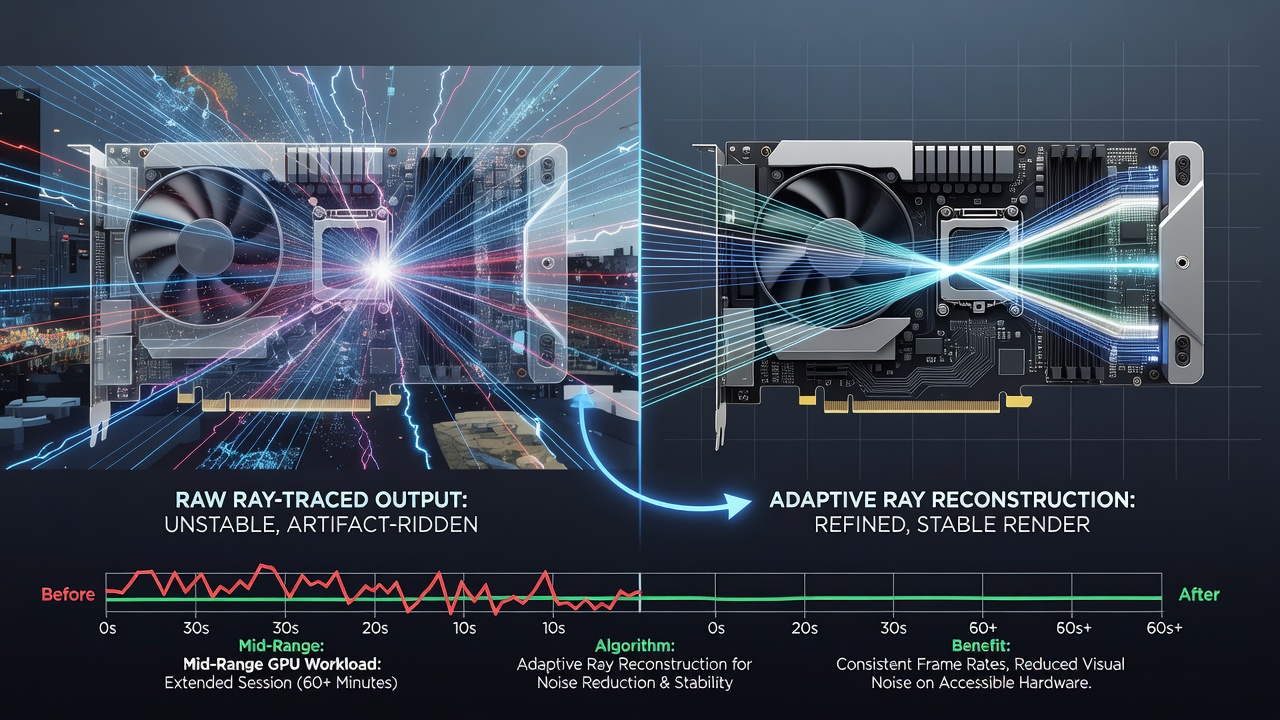
September 2026 saw several cloud service providers roll out updated client software that activates reconstruction by default for sessions exceeding two hours. Metrics collected after these deployments revealed fewer user reports of shimmering foliage and flickering reflections, confirming that the technique scales effectively when hardware sits at the middle of the performance spectrum. Those monitoring the updates observed that power draw remained comparable to baseline runs because the added passes replace heavier traditional denoising kernels rather than stacking on top of them.
Integration With Streaming Pipelines
Encoding stages in cloud consoles already apply temporal compression that can amplify reconstruction artifacts if left unchecked. Adaptive pipelines therefore feed reconstructed buffers directly into the encoder, ensuring that motion-compensated blocks receive cleaner source data. Industry reports from the Entertainment Software Association note that this ordering reduces bitrate requirements for equivalent perceived quality, which benefits users on capped data plans during marathon sessions.
Developers continue to refine heuristic thresholds that decide when reconstruction should increase or decrease sample density. Machine-learning models trained on large corpora of gameplay footage now predict instability several frames ahead, giving the GPU time to allocate resources before visible errors appear. Academic teams at the University of Waterloo have published preliminary results showing that such predictive scheduling further improves consistency metrics on hardware configurations common in portable cloud clients.
Conclusion
Adaptive ray reconstruction supplies a practical pathway for mid-range GPUs to deliver steady visuals throughout lengthy cloud console experiences. By combining temporal reuse, variance-driven sampling, and encoder-aware ordering, the technique offsets limitations in core count and memory bandwidth that would otherwise surface during sustained operation. Continued refinement of scheduling heuristics and API support points toward broader adoption as cloud gaming infrastructure expands in the coming years.