Resistance Tuning Through Dielectric Elastomers Transforms Esports Racing Peripherals
Lars Schmid · Oct 15, 2026
Resistance Tuning Through Dielectric Elastomers Transforms Esports Racing Peripherals
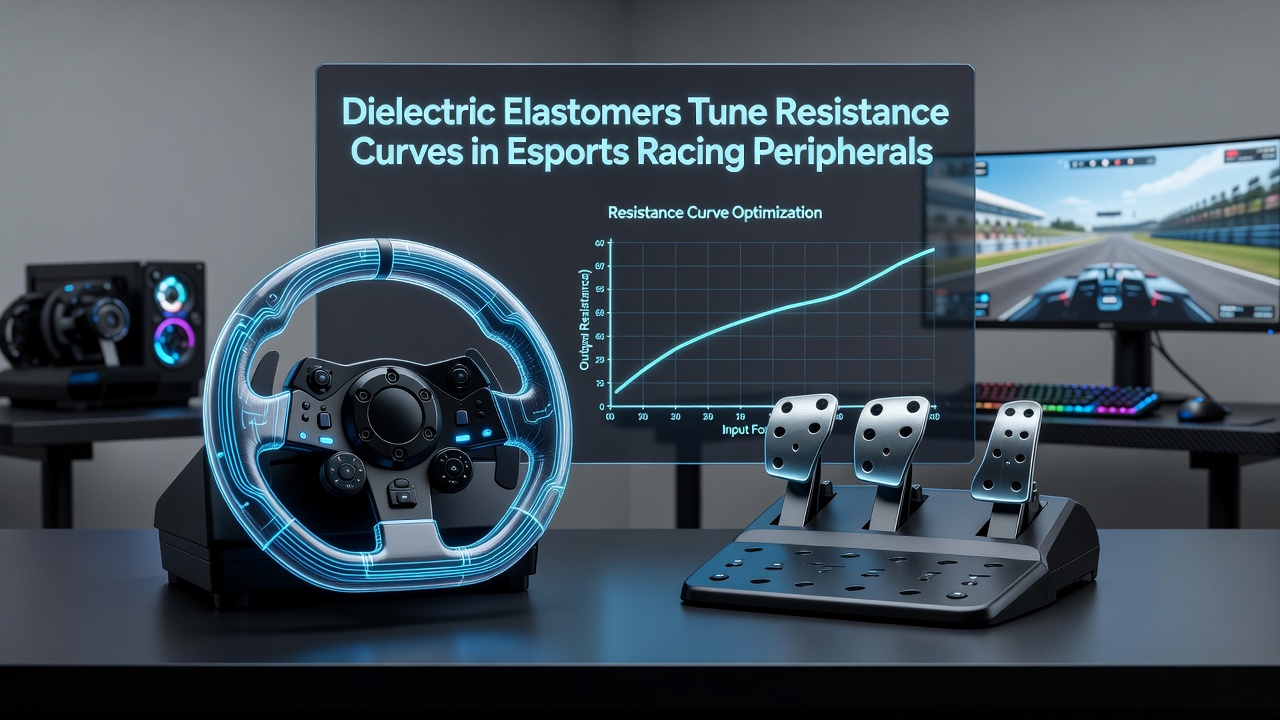
Dielectric elastomers function as electroactive polymers that alter their mechanical properties when subjected to electric fields, and this capability now appears in several esports racing peripheral designs released during 2025 and into October 2026. Manufacturers embed these materials within brake pedal assemblies and steering wheel torque modules so that resistance curves adjust dynamically according to software profiles or sensor input. Data from component suppliers shows that elastomer actuators can change stiffness by up to 40 percent within milliseconds, allowing a single pedal unit to replicate the feel of multiple real-world vehicles without mechanical swaps.
Material Properties and Electrical Control
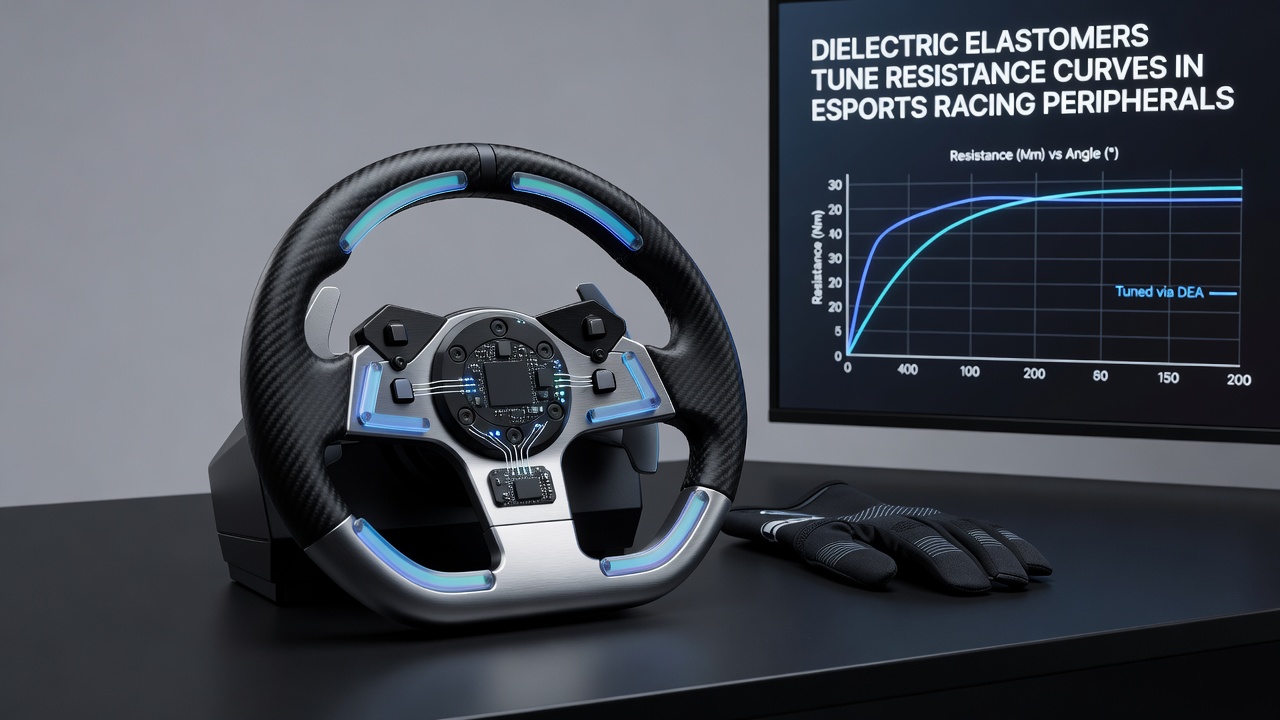
Dielectric elastomers consist of a thin elastomer film coated with compliant electrodes on both sides, and when voltage is applied the film compresses in thickness while expanding in area. Researchers at institutions in Germany and Japan have documented that this deformation produces measurable force changes that translate directly into pedal resistance adjustments. Circuitry inside the peripheral modulates voltage between 0 and 5 kV, producing continuous resistance curves rather than stepped increments typical of traditional spring or damper systems. Calibration routines map voltage levels to force output, and firmware stores multiple profiles that users select through racing software.
Integration in Pedal and Wheel Assemblies
Esports hardware developers mount elastomer stacks between the pedal arm and the base plate, while strain gauges monitor deflection to close the control loop. One study released by the Technical University of Munich in 2025 measured input lag reductions of 2.3 milliseconds compared with solenoid-based variable resistance designs. Steering wheel rims incorporate similar elastomer patches along the torque path, and these patches expand or contract to modulate rotational resistance during cornering simulations. Because the material responds proportionally to voltage, developers program smooth exponential or linear curves that match telemetry data from actual race cars.
Performance Metrics Reported by Teams and Labs
Professional sim racing teams that adopted elastomer-equipped pedals in late 2025 recorded average lap time improvements between 0.15 and 0.4 seconds on standardized test tracks, according to internal telemetry shared at industry events. Laboratory tests conducted at the University of Waterloo in Canada confirmed that resistance repeatability stayed within 1.8 percent across 50,000 actuation cycles. Power consumption remains low at approximately 1.2 watts during active adjustment, which suits extended practice sessions common in esports training regimens. Observers note that the silent operation of elastomer actuators eliminates audible clicks that previously distracted competitors wearing open-back headphones.
Software and Firmware Implementation
Peripheral manufacturers release companion applications that let users import resistance curves derived from real vehicle data logs. The software translates brake pressure versus pedal travel values into voltage sequences that the elastomer controller executes. Updates pushed in September 2026 added support for vehicle-specific telemetry streams from major racing titles, enabling automatic profile switching when drivers change cars mid-session. Error correction routines monitor electrode conductivity and adjust voltage limits to prevent dielectric breakdown during prolonged high-load use.
Supply Chain and Manufacturing Developments
Production of large-area elastomer films scaled in 2025 after two European suppliers qualified new silicone blends with improved dielectric strength. Assembly lines now combine roll-to-roll electrode printing with robotic stacking, which reduces unit cost by roughly 18 percent compared with 2024 models. Component traceability programs track each elastomer batch through final calibration, and several esports organizations require this documentation for hardware used in sanctioned competitions.
Conclusion
Dielectric elastomers continue to expand design options for resistance curves in esports racing peripherals, and adoption data through October 2026 indicates steady integration across both premium and mid-tier product lines. Continued refinement of electrode materials and control algorithms supports further reductions in latency and power draw, while published test results from multiple research groups provide benchmarks for ongoing hardware iterations.