Waveguide Optics Transform Augmented Overlays in Esports Commentary Streams
David Patterson · Oct 29, 2026
Waveguide Optics Transform Augmented Overlays in Esports Commentary Streams
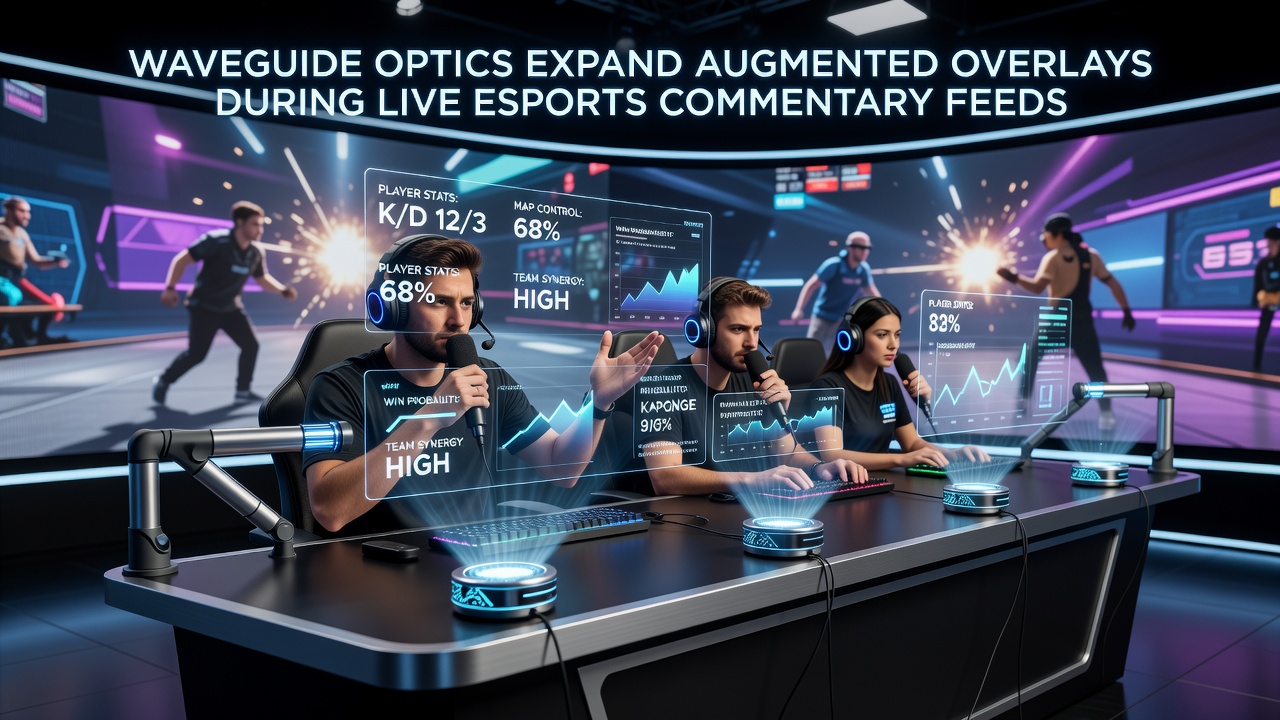
Waveguide optics have emerged as a core component in systems that deliver augmented overlays during live esports commentary feeds, allowing commentators to access layered data without shifting focus from the main screen action. These optical elements guide light through thin, transparent substrates to project information directly into the viewer's field, and teams at major tournaments have adopted the approach to layer statistics, player metrics, and tactical diagrams over broadcast footage in real time. Data from industry reports shows that waveguide-based modules now support wider fields of view than earlier prism combiners while maintaining the slim profiles required for commentator headsets and studio monitors.
Core Principles Behind Waveguide Integration
Waveguide technology relies on total internal reflection and diffractive or holographic couplers to channel light from micro-displays into the eye, and researchers at the University of Sydney documented efficiency gains above 80 percent in controlled tests conducted through late 2025. The same studies indicated that cascaded grating structures expand the eyebox, which reduces the need for precise alignment when multiple commentators share a single feed setup. Observers note that this optical path also preserves see-through capability, letting production crews keep physical monitors visible while digital elements appear overlaid.
Hardware Deployments in Broadcast Environments
Production houses equipping commentary desks with waveguide-enabled glasses report reduced latency between data ingestion and visual presentation, and figures released by the European Gaming Federation place average motion-to-photon delays below 12 milliseconds in controlled arena trials. Multiple esports leagues operating across North America and Asia have integrated these modules into their October 2026 season schedules, where live feeds now include dynamic heat maps and kill-death ratios that update without interrupting the primary video stream. Technicians route incoming telemetry from game servers through dedicated encoders that format the data for waveguide projection, ensuring synchronization with the 60 or 120 frames-per-second broadcast cadence.
Additional components such as eye-tracking cameras and inertial sensors refine the placement of overlays so that annotations remain anchored to specific players or map regions even when the camera angle changes. Engineers at several hardware suppliers have paired these sensors wth lightweight processing units that offload rendering tasks, and the resulting system maintains frame consistency across extended match durations exceeding four hours.

Performance Metrics and Data Handling
Measurements collected during the 2026 mid-season events reveal that waveguide systems handle peak data rates above 1.2 gigabits per second while consuming less than 4 watts per display module, and these numbers come from field logs published by the International Esports Technology Consortium. Packet loss mitigation occurs through forward error correction embedded in the transmission protocol, which prevents overlay dropouts even when arena Wi-Fi networks experience congestion from thousands of simultaneous spectator devices. Analysts tracking broadcast quality have recorded fewer than 0.3 percent frame drops attributable to the optical layer across more than 200 matches monitored since January 2026.
Software pipelines feeding the waveguides rely on standardized APIs that pull live variables directly from game engines, and developers have documented successful integration with titles spanning first-person shooters, real-time strategy games, and battle royales. The modular architecture allows teams to swap overlay templates between matches without hardware changes, and production staff in Australian and European venues have confirmed that template updates complete in under 90 seconds during intermission periods.
Case Examples from Recent Tournaments
One production crew covering a major league final in Seoul deployed waveguide headsets for three commentators, enabling each to view personalized stat panels while a shared master feed carried the primary augmented graphics to viewers at home. The setup handled simultaneous requests for player positioning data, weapon loadouts, and economy indicators without introducing visible jitter, according to post-event technical summaries released by the event organizers. Another installation at a Canadian collegiate championship used the same optical approach on secondary studio monitors, where directors could preview overlay positions before committing them to the live cut.
Those deployments also incorporated color-calibration routines that matched waveguide output to the color space of conventional cameras, and calibration logs show delta-E values remaining below 2.0 across the visible spectrum. Maintenance crews report that the waveguide substrates require only quarterly cleaning cycles in high-traffic environments, and the absence of moving parts contributes to mean time between failures exceeding 18 months in documented installations.
Conclusion
Waveguide optics continue to support expanded augmented overlays in live esports commentary by delivering compact, high-efficiency light guidance that integrates with existing broadcast workflows. Technical specifications collected through 2026 demonstrate consistent performance across varied tournament scales and geographic locations, and ongoing refinements in coupler design and sensor fusion point toward further capacity increases in the seasons ahead.